
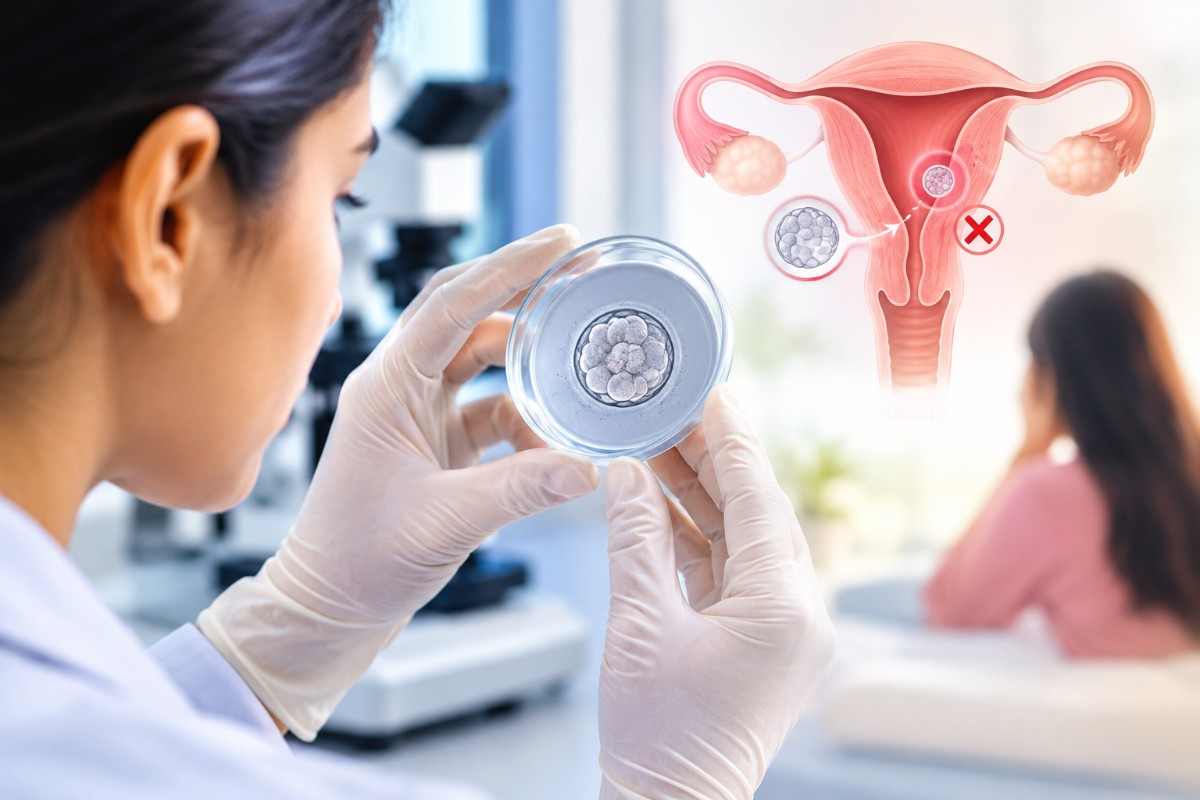
IVF can feel especially confusing when doctors say an embryo looks “perfect,” yet pregnancy does not occur. Patients naturally wonder: If the embryo looked healthy, why didn’t it implant?
The important thing to understand is that an embryo’s appearance is only one part of the IVF process. Embryo grading helps embryologists assess its development and appearance under a microscope, but it cannot reveal every factor that determines whether an embryo will implant and develop into a healthy pregnancy.
Several factors involving the embryo, uterus, sperm, hormones and overall reproductive health can influence IVF outcomes.
What Does a “Perfect” Embryo Mean?
During IVF, embryos are assessed based on characteristics such as their rate of development, cell organization and appearance. A well-developed embryo with favourable characteristics may receive a high grade.
However, embryo grading is not the same as genetic testing.
An embryo can look excellent under a microscope while still carrying a chromosomal abnormality that may prevent implantation or lead to an early miscarriage. Conversely, an embryo with a lower visual grade can sometimes result in a successful pregnancy.
Therefore, embryo appearance is useful information, but it does not provide a complete picture of an embryo’s reproductive potential.
1. Chromosomal Abnormalities in the Embryo
One of the most important reasons IVF can fail despite a good-looking embryo is an underlying chromosomal abnormality.
As embryos develop, errors can occur during cell division. These abnormalities may make implantation difficult or prevent the embryo from developing normally.
The likelihood of chromosomal abnormalities generally increases with maternal age, although they can occur at any reproductive age.
In selected situations, doctors may discuss preimplantation genetic testing for aneuploidy (PGT-A). PGT-A examines cells from an embryo to identify certain chromosome-number abnormalities before embryo transfer.
PGT-A is not necessary or appropriate for every IVF patient. Its usefulness depends on individual circumstances, and the decision should be made with a fertility specialist.
2. Uterine and Endometrial Factors
Even a healthy embryo needs a receptive uterus to implant.
The endometrium, or uterine lining, undergoes changes throughout the menstrual cycle to prepare for implantation. If the lining is not developing appropriately, implantation may be affected.
Factors that may need evaluation include:
- Endometrial thickness and development
- Uterine fibroids
- Endometrial polyps
- Adenomyosis
- Scar tissue inside the uterus
- Congenital uterine abnormalities
- Certain forms of endometriosis
A fertility specialist may recommend an ultrasound, hysteroscopy or other investigations when clinically appropriate.
3. Timing of Embryo Transfer
Implantation depends not only on embryo quality but also on the timing between embryo development and endometrial receptivity.
The uterus has a period during which it is most prepared to receive an embryo. Hormonal changes help coordinate this process.
In some patients, particularly those with repeated implantation failure, doctors may investigate whether the timing of progesterone exposure and embryo transfer is appropriate.
Tests such as an endometrial receptivity assessment may be considered in selected cases, although their role should be individualized rather than routinely assumed to improve outcomes for everyone.
4. Hormonal and Medical Conditions
Hormonal balance plays an important role throughout an IVF cycle.
Conditions such as thyroid disorders, uncontrolled diabetes, elevated prolactin levels and certain ovulatory or metabolic problems may affect fertility and pregnancy outcomes.
Polycystic ovary syndrome (PCOS), endometriosis and other reproductive conditions can also influence the IVF journey.
This does not mean that having one of these conditions automatically causes IVF failure. Instead, proper diagnosis and management can help doctors identify factors that may need attention before another treatment cycle.
5. Sperm Factors Can Also Matter
IVF is often discussed mainly in terms of the egg and embryo, but sperm quality also contributes to embryo development.
Even when fertilization occurs and an embryo reaches the blastocyst stage, sperm-related factors may potentially contribute to embryo development and reproductive outcomes.
Depending on the couple’s history, doctors may evaluate semen parameters and consider additional investigations when indicated.
Advanced laboratory techniques such as ICSI (Intracytoplasmic Sperm Injection) may be recommended in specific circumstances, particularly when there are significant sperm-related fertility problems.
However, ICSI is not a guarantee of implantation or pregnancy.
6. Embryo Implantation Is a Complex Biological Process
Implantation is not a simple “embryo attaches to uterus” event. It involves a highly coordinated interaction between the embryo and the endometrium.
The embryo must continue developing, hatch from its surrounding protective layer and interact with the receptive endometrial environment.
Many biological processes occur during this period, and not all of them can be measured through routine IVF testing.
This is why even with excellent laboratory conditions and a favourable embryo grade, implantation cannot be guaranteed.
7. Age and Egg Quality
Age is another important factor in IVF outcomes.
As women age, the number and quality of eggs generally decline. The proportion of eggs and embryos with chromosomal abnormalities also tends to increase.
This means that retrieving several eggs does not necessarily mean that several chromosomally normal embryos will be available for transfer.
Age is only one factor, however. Individual ovarian reserve, reproductive history, sperm factors and underlying medical conditions also need to be considered.
8. Sometimes There Is No Single Identifiable Reason
One of the hardest parts of IVF treatment is that a failed cycle does not always have one obvious explanation.
A patient may have:
- A good-quality blastocyst
- An apparently healthy uterine lining
- Appropriate hormone levels
- A technically successful embryo transfer
…and still not achieve pregnancy.
This does not necessarily mean that something was done incorrectly.
Human reproduction is biologically complex, and even under favourable circumstances, implantation is not guaranteed.
What Happens After an IVF Failure?
After an unsuccessful IVF cycle, the next step should not automatically be another identical cycle.
Your fertility specialist may review:
- The number and quality of eggs retrieved
- Fertilization results
- Embryo development and grading
- Previous embryo transfers
- Endometrial thickness and uterine anatomy
- Hormonal factors
- Sperm parameters
- Age and ovarian reserve
- Previous pregnancy or miscarriage history
- Any underlying reproductive or medical conditions
Based on this review, your doctor may recommend additional investigations or modify the treatment approach.
Importantly, one unsuccessful IVF cycle does not mean that IVF will never work. The appropriate next step depends on the individual clinical picture.
When Should You Speak to a Fertility Specialist?
If IVF has failed despite apparently good-quality embryos, discuss the outcome with your fertility specialist before making decisions about another cycle.
Ask your doctor what the embryo grading means, whether your uterus and endometrium have been adequately evaluated, whether additional testing is clinically appropriate, and what factors could be addressed before another transfer.
Every IVF journey is different. Understanding the possible reasons for failure can help couples have a more informed conversation with their fertility team.
Conclusion
A “perfect-looking” embryo is encouraging, but embryo appearance alone cannot predict IVF success.
Chromosomal factors, uterine receptivity, endometrial development, hormone balance, sperm factors, age and several biological processes can influence implantation and pregnancy. In some cases, no single cause can be identified.
The goal after an unsuccessful IVF cycle is not simply to repeat treatment, but to review the complete clinical picture and identify whether there are factors that can be evaluated or addressed.
If you are experiencing repeated IVF failure, a personalized assessment by a fertility specialist can help determine the most appropriate next step for your situation.