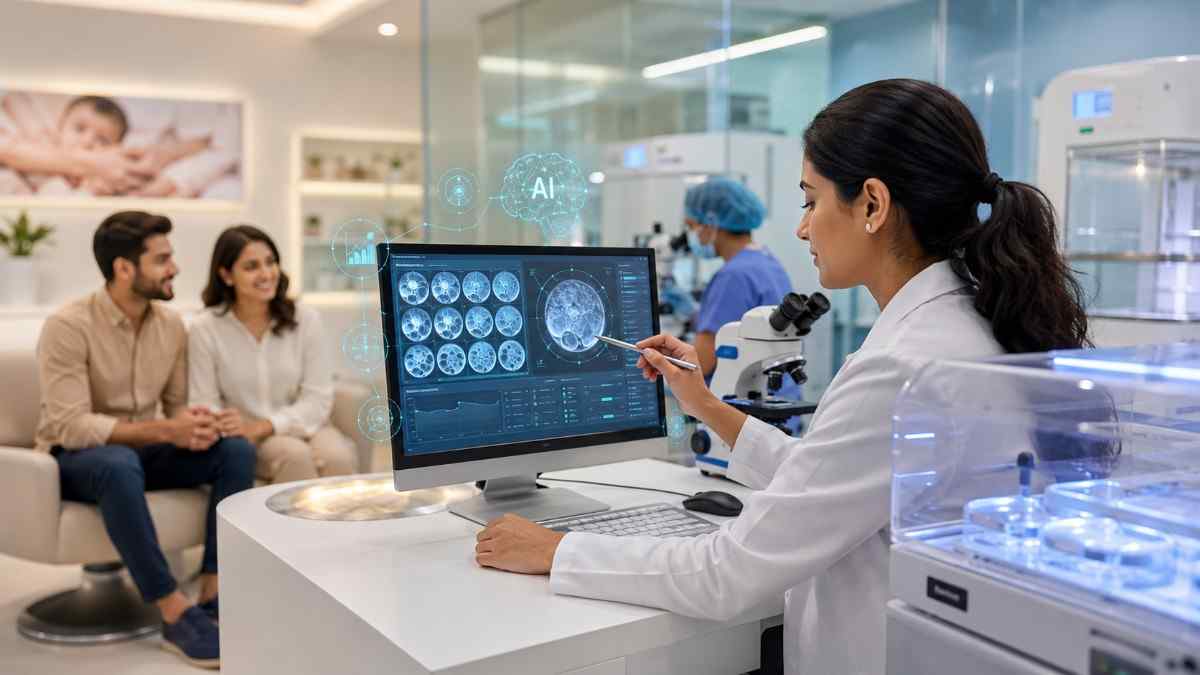

Artificial intelligence (AI) is becoming an increasingly important technology in modern fertility care. In 2026, IVF laboratories are using AI-based tools to support embryologists in areas such as embryo assessment, sperm analysis, laboratory monitoring, and treatment decision-making.
For patients undergoing IVF, this can sound exciting but it can also raise questions. Does AI choose the best embryo? Can it guarantee pregnancy? Will a computer replace an embryologist?
The simple answer is no. AI is designed to support fertility specialists and embryologists by analysing large amounts of information and identifying patterns that may be difficult to assess consistently with the human eye. It is a supporting technology, not a replacement for medical expertise.
Understanding how AI is being used can help IVF patients make informed decisions and have realistic expectations about treatment.
What Is AI in an IVF Laboratory?
AI refers to computer systems that can analyse information, recognise patterns, and assist with predictions or classifications.
In an IVF laboratory, AI can be trained using large datasets containing information such as embryo images, time-lapse development patterns, sperm characteristics, and laboratory measurements. Depending on the technology, these systems may help embryologists assess biological characteristics and identify embryos that show patterns associated with better developmental potential.
However, AI does not “know” whether an embryo will definitely result in a healthy baby. IVF outcomes depend on multiple factors, including embryo genetics, maternal age, uterine health, sperm factors, and other biological factors.
How Is AI Being Used in IVF Labs in 2026?
1. AI-Assisted Embryo Assessment
One of the most discussed applications of AI in IVF is embryo assessment.
Traditionally, embryologists evaluate embryos based on their appearance and developmental characteristics at specific stages. AI-based systems can analyse embryo images and, in some laboratories, time-lapse images collected throughout development.
The technology may identify patterns related to embryo development and help embryologists rank or prioritise embryos for consideration.
This can be especially useful because embryo selection involves complex information that may be difficult to evaluate consistently.
2. Time-Lapse Embryo Monitoring
Time-lapse incubators allow embryos to be monitored continuously without repeatedly removing them from controlled incubation conditions.
AI can analyse the large amount of image data generated by these systems. Instead of relying only on observations at selected time points, embryologists can potentially review developmental patterns across a much longer period.
This may provide additional information about how an embryo develops rather than focusing on a single snapshot.
3. Supporting Sperm Analysis
AI is also being explored and used in advanced semen-analysis systems.
Computer-assisted technologies can analyse sperm characteristics such as movement and concentration. Some systems can process large numbers of sperm cells and identify patterns more rapidly and consistently than manual assessment alone.
For men with abnormal semen parameters, these technologies may provide additional laboratory information that can support fertility treatment planning.
4. Laboratory Quality Control
IVF success depends not only on embryos and reproductive health but also on maintaining highly controlled laboratory conditions.
AI and automated monitoring systems can help laboratories track environmental parameters such as temperature, gas levels, humidity, equipment performance, and other laboratory variables.
Continuous monitoring may help laboratory teams identify unusual changes quickly and take appropriate action.
5. Data-Based Treatment Support
IVF generates a significant amount of clinical and laboratory data. AI can potentially help analyse multiple variables together.
For example, fertility teams may use data-driven tools to support the evaluation of treatment history, embryo development, or other laboratory information.
Importantly, these systems should be viewed as decision-support tools, rather than independent decision-makers.
Can AI Pick the “Best” Embryo?
This is one of the most common questions patients ask.
AI may help identify embryos with characteristics associated with better developmental potential, but it cannot guarantee which embryo will implant or result in a healthy pregnancy.
An embryo that receives a favourable AI-based assessment may not implant, while another embryo with a less favourable prediction may still result in pregnancy.
Embryo selection is influenced by many biological factors, and not all of them can be measured through an image or computer model.
Therefore, patients should be cautious about clinics or technologies that present AI as a guarantee of IVF success.
Does AI Replace Embryologists?
No.
Embryologists remain essential to IVF laboratory care. They are trained professionals who handle embryos, operate laboratory equipment, assess developmental characteristics, maintain quality standards, and make decisions within the clinical team.
AI can process information quickly and consistently, but an embryologist understands the laboratory context and can interpret information alongside the patient's individual treatment plan.
The ideal approach is often human expertise supported by advanced technology.
Can AI Improve IVF Success Rates?
AI has significant potential, but patients should understand the difference between potential benefits and proven outcomes.
Some AI technologies have shown promising results in research and clinical applications, particularly in embryo assessment and laboratory monitoring. However, performance can vary between systems, laboratories, patient populations, and datasets.
An AI score alone should not be considered a guarantee of implantation, pregnancy, or live birth.
A patient's overall IVF outcome depends on several factors, including age, ovarian reserve, egg and sperm quality, embryo development, uterine factors, genetic factors, and the specific treatment strategy.
What Should Patients Ask Their IVF Clinic About AI?
If your fertility clinic uses AI-based technology, it is reasonable to ask questions before treatment.
You can ask:
- What AI technology does the laboratory use?
- What exactly does the technology assess?
- Is AI being used to support embryo selection or for another purpose?
- How is the AI result combined with the embryologist's assessment?
- Is the technology clinically validated?
- Does using AI change the treatment plan or embryo-transfer decision?
- What evidence supports its use?
These questions can help you understand whether AI is being used as a meaningful laboratory support tool or simply as a marketing feature.
Is AI Safe for IVF Patients?
AI itself does not replace the laboratory procedures used to culture, freeze, thaw, or transfer embryos.
When AI is integrated into an IVF laboratory, the technology generally analyses information generated from laboratory systems, images, or other data. Patient safety still depends heavily on laboratory protocols, equipment, quality control, embryologist expertise, and clinical decision-making.
Patients should therefore look at the overall quality of the IVF laboratory, rather than choosing a clinic solely because it advertises AI.
The Future of AI and IVF
AI is likely to become more sophisticated as researchers gain access to larger and better-quality datasets.
Future developments may include improved embryo assessment, more personalised treatment-support tools, automated laboratory monitoring, advanced sperm analysis, and better integration of clinical and laboratory data.
At the same time, responsible use of AI will require attention to data privacy, transparency, validation, bias, and clinical safety.
The most valuable role of AI may not be replacing human decisions but helping fertility teams make more informed decisions using a broader range of information.
Conclusion
AI is changing the way IVF laboratories analyse information and support embryologists. From embryo assessment and time-lapse monitoring to sperm analysis and laboratory quality control, AI can offer useful tools for modern fertility care.
But patients should remember one important point: AI is a support system not a guarantee of IVF success.
Your fertility specialist and embryology team should consider AI-generated information alongside your medical history, reproductive factors, embryo characteristics, and treatment goals.
If you are considering IVF in 2026, ask your fertility clinic how AI is being used, what evidence supports the technology, and how it fits into your individual treatment plan. The combination of advanced technology, experienced embryologists, and personalised medical care can help create a more informed approach to fertility treatment.