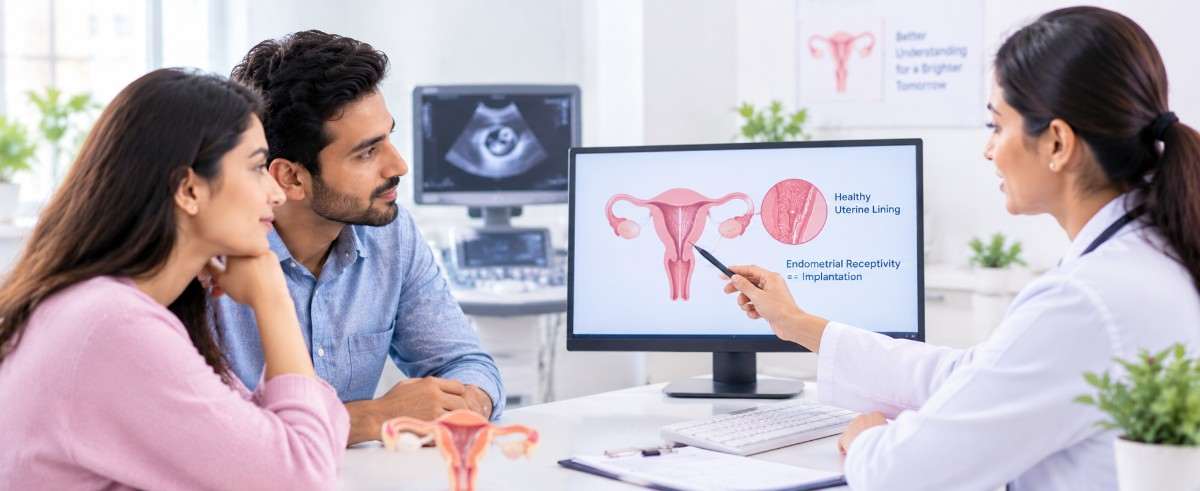
What Is Endometrial Receptivity and Why Does the Uterine Lining Matter in IVF?
For an IVF cycle to result in pregnancy, developing a healthy embryo is only one part of the process. The uterus also needs to be prepared to receive that embryo. The inner lining of the uterus, known as the endometrium, undergoes important changes throughout the menstrual cycle to create the right environment for implantation.
This is where endometrial receptivity becomes important. It refers to the temporary period when the uterine lining is biologically prepared to allow an embryo to attach and begin implantation. Successful implantation depends on several factors working together, including embryo development, endometrial preparation and the timing between the embryo and the uterine lining.
Understanding the role of the endometrium can help patients better understand what happens before and during embryo transfer in IVF Treatment.
What Is Endometrial Receptivity?
Endometrial receptivity is the state in which the lining of the uterus becomes suitable for an embryo to attach and implant.
During a natural menstrual cycle, hormones such as estrogen and progesterone guide changes in the endometrium. Estrogen helps the lining grow during the earlier part of the cycle, while progesterone helps transform it into a more suitable environment for implantation after ovulation.
This preparation does not continue indefinitely. There is a limited period commonly called the window of implantation, during which the endometrium is most receptive to a developing blastocyst.
In IVF, doctors aim to coordinate embryo development and endometrial preparation so that the embryo reaches the uterus when the lining is appropriately prepared.
Why Does the Uterine Lining Matter in IVF?
An embryo needs more than good developmental potential to implant. It also needs an endometrium that is appropriately prepared.
Implantation involves a series of events. The embryo first comes into contact with the uterine lining, attaches to it and then begins to invade the underlying endometrial tissue. This process involves complex communication between the embryo and the endometrium.
This means that IVF success is not determined by embryo quality alone.
A useful way to think about it is that the embryo and uterus need to be ready at the right time. If their development is not synchronized, implantation may be less likely.
However, it is important to remember that implantation can be affected by many factors. Embryo chromosomal abnormalities, uterine conditions, age, hormonal factors and other aspects of reproductive health can all influence IVF outcomes.
What Happens to the Endometrium During an IVF Cycle?
During IVF, the endometrium is carefully monitored and prepared for embryo transfer.
Depending on the type of IVF cycle, preparation may involve the body's natural hormones or medications containing estrogen and progesterone.
1. Estrogen Helps Build the Lining
During the first part of the menstrual cycle, estrogen stimulates the growth and development of the endometrium.
In a frozen embryo transfer cycle using hormonal preparation, estrogen medication may be prescribed to help develop the uterine lining before progesterone is introduced.
2. Progesterone Changes the Lining
After ovulation in a natural cycle, or after progesterone is started in a prepared cycle, the endometrium undergoes further changes.
These changes are important because the lining needs to move from a growth phase into a state that can support embryo implantation.
3. Embryo Transfer Is Timed Around Endometrial Preparation
For a frozen embryo transfer, the timing of progesterone exposure is particularly important because it helps coordinate the developmental stage of the endometrium with the age of the embryo.
The goal is to create synchronization between the embryo and the window of implantation.
Is Endometrial Thickness the Same as Endometrial Receptivity?
Not exactly.
Endometrial thickness is one of the measurements doctors may assess using ultrasound, while endometrial receptivity is a much broader biological concept.
An ultrasound can provide information about the appearance and thickness of the uterine lining, but thickness alone cannot completely determine whether an endometrium is receptive. Research has also shown that several factors can influence both endometrial measurements and IVF outcomes.
Therefore, patients should not assume that a particular lining measurement automatically guarantees implantation or pregnancy.
Your fertility specialist considers the ultrasound findings along with your hormonal environment, uterine health, embryo characteristics and treatment history.
What Can Affect Endometrial Receptivity?
Several factors may influence the ability of the endometrium to support implantation.
These can include:
- Hormonal imbalance or inadequate hormonal preparation
- Uterine fibroids or polyps
- Adenomyosis or endometriosis
- Intrauterine adhesions or scarring
- Certain forms of chronic endometrial inflammation
- Problems affecting the uterine cavity
- Inadequate or abnormal endometrial development
- Timing differences between embryo development and endometrial preparation
Importantly, having one of these conditions does not automatically mean IVF will fail. Many uterine or hormonal factors can be evaluated and, when appropriate, treated or managed before embryo transfer.
How Do Doctors Evaluate the Uterine Lining Before Embryo Transfer?
The evaluation depends on the patient's medical history and the IVF protocol.
Ultrasound Assessment
Transvaginal ultrasound is commonly used to examine the endometrium before embryo transfer. Doctors may assess its thickness and appearance and also look at the uterus for abnormalities.
Hormonal Assessment
Estrogen and progesterone exposure are important for endometrial development. Depending on the treatment cycle, the fertility team may monitor hormone levels and medication timing.
Evaluation of the Uterine Cavity
If there is a concern about the uterus, additional investigations may be recommended. These can include procedures such as saline sonography or hysteroscopy, depending on the clinical situation.
These evaluations can help identify structural problems that may interfere with implantation.
What Is an Endometrial Receptivity Analysis or ERA Test?
You may have heard of the Endometrial Receptivity Analysis (ERA), a molecular test designed to assess gene-expression patterns associated with endometrial receptivity.
The idea behind the test is to identify whether the endometrium appears receptive at a particular point and, in some cases, use the result to personalize the timing of progesterone exposure and embryo transfer.
However, ERA testing should not be considered a routine test for every IVF patient.
Current evidence remains mixed. The American Society for Reproductive Medicine's 2026 committee opinion states that there is insufficient evidence to support routine use of endometrial receptivity testing, including ERA, in recurrent implantation failure. A large randomized trial also did not show a significant improvement in live birth when ERA-guided timing was compared with standard timing for transfer.
Therefore, whether such testing is appropriate should be discussed individually with a fertility specialist rather than treated as a standard requirement before IVF.
Can a Thin Endometrium Affect IVF?
A thinner-than-expected endometrium may be associated with poorer reproductive outcomes in some IVF settings, but thickness should not be interpreted in isolation.
The relationship between endometrial thickness and IVF outcome is complex, and studies have limitations. Doctors therefore consider the complete clinical picture rather than relying on a single measurement.
If the lining does not develop as expected, the fertility team may review factors such as medication response, estrogen exposure, uterine anatomy and previous treatment history.
The appropriate approach depends on the reason for the problem.
Can You Improve Endometrial Receptivity Naturally?
There is no single food, supplement or lifestyle change proven to guarantee better endometrial receptivity or implantation.
However, maintaining overall reproductive health is still valuable. Patients preparing for IVF can focus on:
- Eating a balanced and nutritious diet
- Avoiding smoking and tobacco
- Limiting alcohol according to medical advice
- Maintaining a healthy level of physical activity
- Managing conditions such as thyroid disorders or diabetes with appropriate medical care
- Taking prescribed medications exactly as directed
- Attending recommended scans and follow-up appointments
- Getting adequate sleep and managing stress
Patients should also be cautious about supplements or “implantation boosters” promoted online. Not every treatment marketed for improving the uterine lining has strong scientific evidence behind it.
Does Endometrial Receptivity Guarantee IVF Success?
No.
A receptive endometrium is an important part of implantation, but it cannot guarantee pregnancy.
IVF involves several stages, and outcomes can be influenced by embryo chromosomal status, egg and sperm factors, age, uterine health, infertility diagnosis, embryo transfer technique and other biological factors.
Research describes implantation as a coordinated interaction between a developmentally competent embryo and a receptive endometrium.
This is why fertility treatment should be individualized rather than based on one test or measurement.
When Should You Talk to a Fertility Specialist About the Uterine Lining?
A specialist may pay particular attention to the endometrium when:
- The lining repeatedly develops poorly during treatment
- There have been repeated embryo implantation failures
- Ultrasound suggests a possible uterine abnormality
- There is a history of fibroids, polyps, endometriosis or adenomyosis
- There is a history of uterine surgery or adhesions
- Previous embryo transfers have not resulted in pregnancy
Importantly, repeated implantation failure does not automatically mean that the endometrium is the problem. Current clinical guidance recommends evaluating multiple possible causes rather than assuming that one factor explains every unsuccessful transfer.
Conclusion
The uterine lining plays an important role in IVF because an embryo needs an appropriately prepared endometrium in order to implant. Endometrial receptivity describes the temporary biological state in which the lining is prepared to receive an embryo.
Doctors may evaluate the endometrium through ultrasound, hormonal assessment and, when clinically appropriate, investigation of the uterine cavity. Although tests such as ERA have generated interest in personalized embryo transfer, current evidence does not support their routine use for every IVF patient.
Most importantly, IVF success depends on several interconnected factors. A healthy embryo, a suitable uterine environment and appropriate timing all contribute to the implantation process. Working with a fertility specialist can help determine which evaluations and treatments are genuinely appropriate for your individual situation.